• Professional healthcare
  • Products & Services
  • Inspiration
  • Support & Contact
  • Shop
‌
‌
‌
‌
‌
‌
‌
‌
‌
‌
‌
‌
‌
‌
‌
‌
‌
‌
‌
‌
  • Consumer productsConsumer products
    • Home
    • Support
    • Product registration
    • My Philips
  • Healthcare professionalsHealthcare professionals
    • Home
    • Products
    • Services
    • Specialties
    • Solutions
  • Other business solutionsOther business solutions
    • Lighting
    • Automotive
    • Dictation Solutions
    • More
    • Hearing solutions
    • Display solutions
  • About usAbout us
    • Home
    • News
    • Investor Relations
    • Careers
    • More
    • Innovation
    • Environmental, Social and Governance
  • Contact and supportContact and support
    • Customer support
    • Professional healthcare support
    • Company contacts
  • Stay up-to-dateStay up-to-date
  • Select your country / languageGlobal / English
  • Privacy Notice
  • Terms of use
  • Cookie notice
© Koninklijke Philips N.V., 2004 - 2025. All rights reserved.
‌
‌
‌
‌
‌
‌
‌
‌
‌
‌
‌
‌
‌
‌
‌
‌
‌
‌
‌
‌

Study of 12-year-old boy with low-grade glioma at Hosp. Infantil Univ. Niño Jesús

  • Featuring
  • March 04 2025
  • Duration 7:11

Pediatric imaging requires a specialized approach considering age, size, and development. Dr. Solís explores pediatric MR imaging complexities through a follow-up case of a 12-year-old boy with a low-grade glioma. To reproduce these protocols on your 3.0T Philips MR scanner: Review full clinical case and download ExamCard: https://www.mriclinicalcasemap.philips.com/global/case/293 Review full clinical case and download protocol files: ExamCards & Protocols (Already registered to MyP4P Community? Login first here and then open the protocol page here. Not yet a member, sign up here.)

MR case review: Follow-up study of a 12-year-old boy with a low grade glioma at Hospital Infantil Universitario Niño Jesús

At-a-glance:

  • 00:19] Previous MR brain study on a 1.5T Mobile MR
  • [02:08] New MR brain study on 3.0T (MR 7700)
  • 02:32] Benefits of 3D T2w sequences with fat suppression (SPAIR), allowing reconstructions in multiple directions.
  • [04:06] Benefits of using a sagittal, high resolution, balanced FFE sequence of the brain midline, allowing to see tiny structures.
  • [05:58] Post-gadolinium images showing nodule enhancement
  • [06:18] Tumor tracking used for lesion follow-up, allowing measurements and segmentation.

This is a really nice sequence with really high resolution, that in this case has changed our diagnosis.
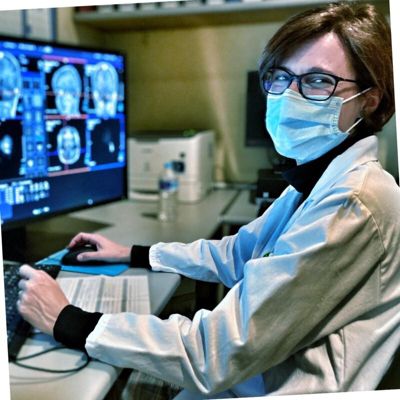
Ines Soliz.jpg
Dr. Inés Solís Muñiz
Pediatric Radiologist
Hospital Infantil Universitario Niño Jesús, Madrid, Spain
Copy this URLto share this story with your professional network
Sign up for news and updates
Lady using a tablet
Disclaimer
Results are specific to the institution where they were obtained and may not reflect the results achievable at other institutions. Results in other cases may vary.